Text: VIONNE Magazine | Fashion & Accessories Designer: Elena Zharkova | Photographer: Anna Mosunova | Model: Elena Zharkova
From City to Silhouette
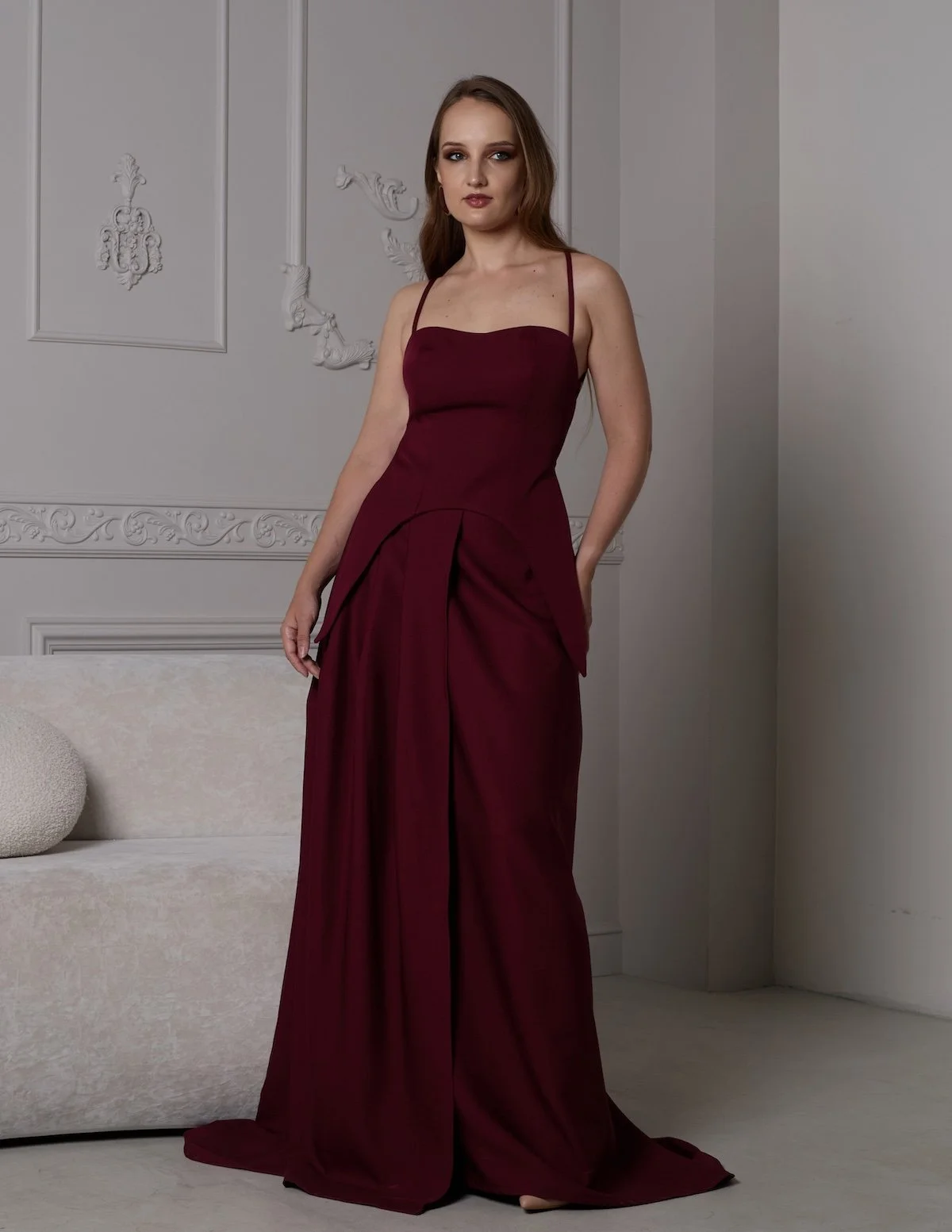
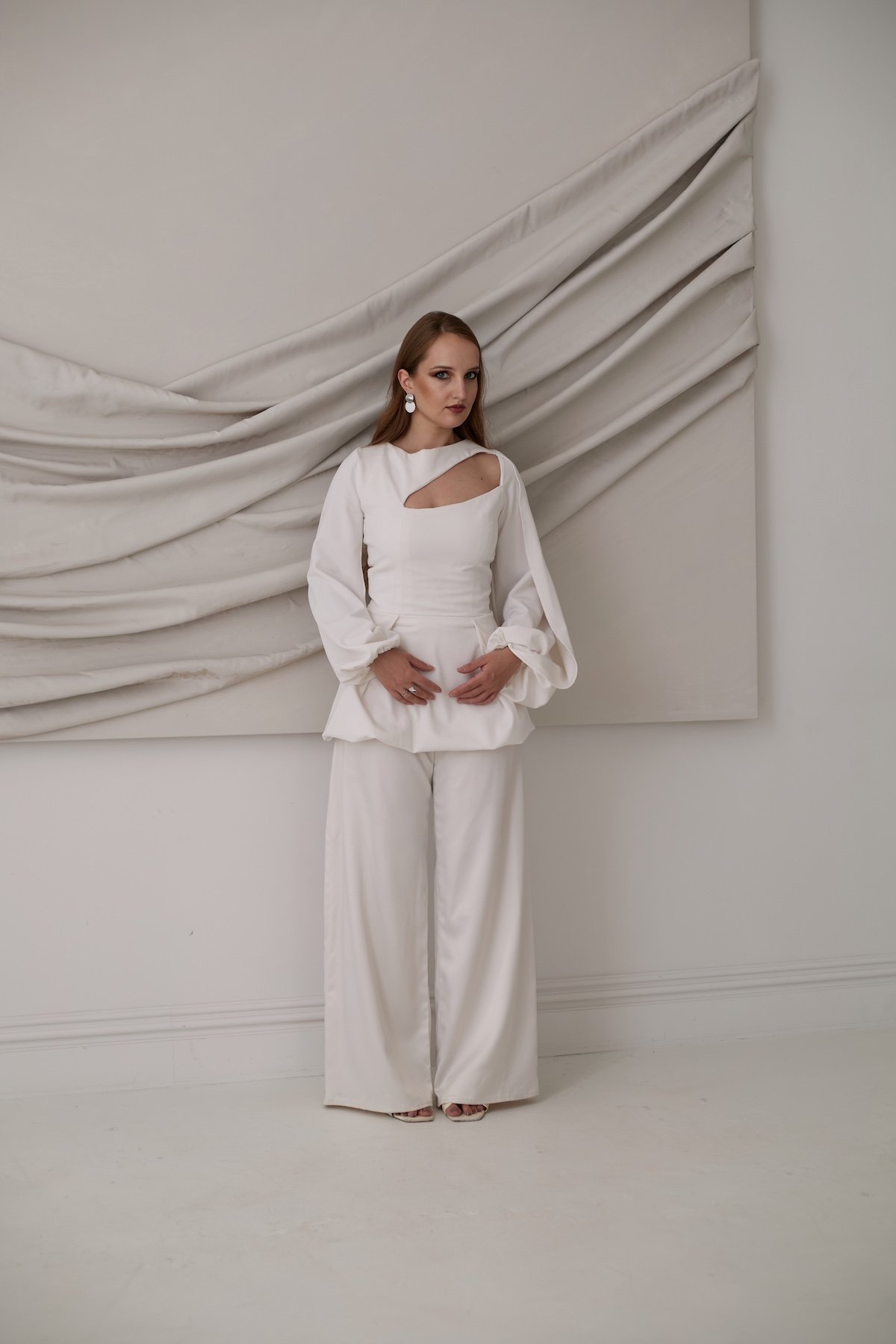
In Living Architecture, designer Elena Zharkova transforms the disciplines that shaped her life into a single visual language. Before fashion, she studied academic drawing and later architecture, learning to think through proportion, light, structure, rhythm, and space. Those principles now reappear in fabric: the sweeping lines of the Brooklyn Bridge, the Art Deco geometry of the Chrysler Building, and the fluid structural thinking of architects such as Santiago Calatrava become silhouettes, sleeves, seams, and moving volumes rather than literal replicas. One of the collection’s most technically demanding pieces — a white two-piece look inspired by Calatrava’s Milwaukee Art Museum — translates the building’s wing-like architecture into voluminous sleeves assembled from hundreds of individually prepared fabric strips.
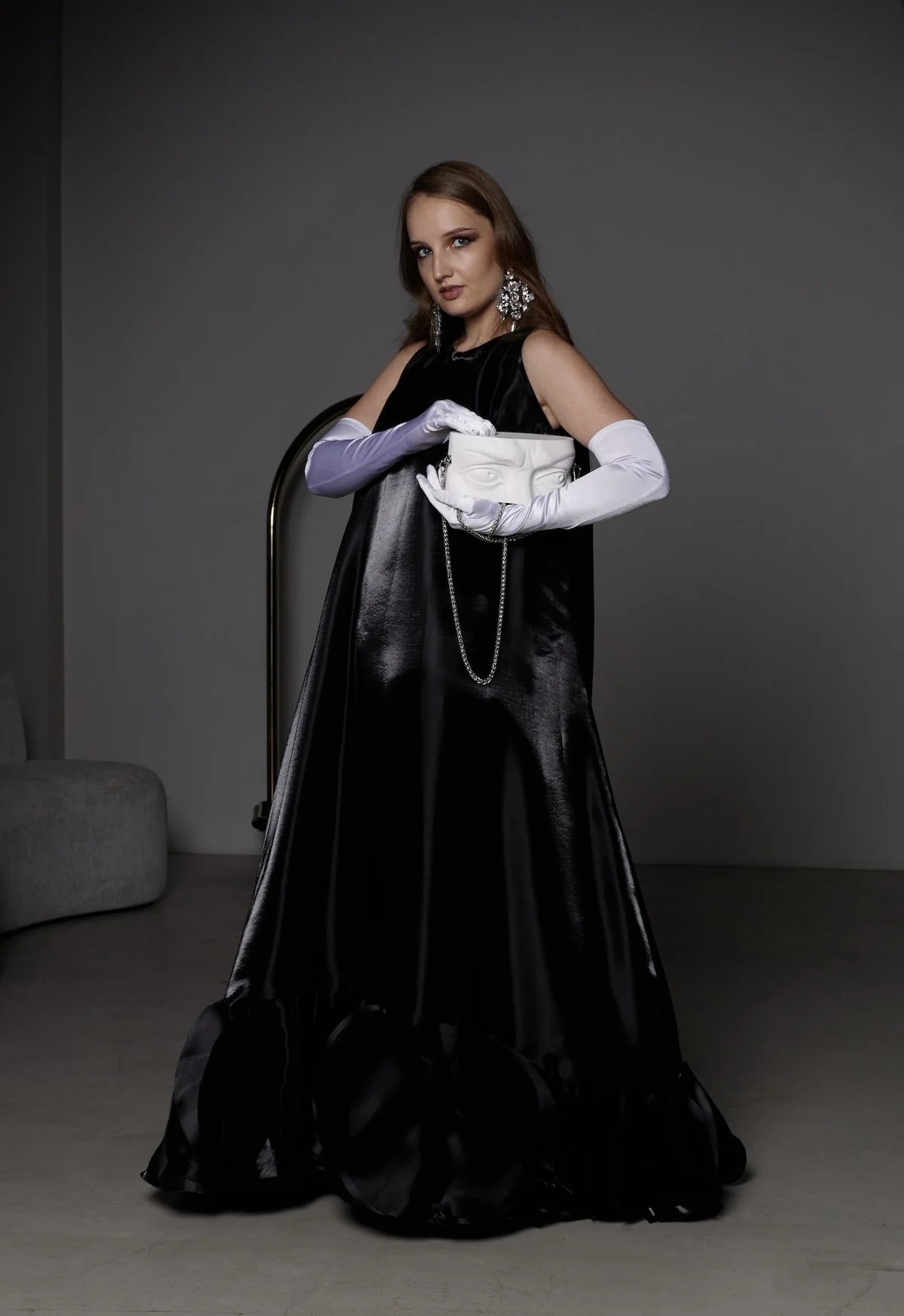
What makes the collection particularly personal is the way Zharkova’s own creative history keeps resurfacing inside it. The gaze of Michelangelo’s David, once studied repeatedly during her art education, later became The Eye of David, a sculptural handbag she designed through 3D modeling, printed, and finished by hand — and which has since received a Silver Award at the Rome Design Awards. That same dialogue between memory, craftsmanship, and technology runs throughout her practice. Zharkova even develops her garments on herself, constantly testing how structure behaves once the body moves. For her, the goal is not architecture frozen in cloth, but architecture brought to life: garments that shift, expand, and reveal new angles as they are worn.
Interview with Elena Zharkova
VIONNE: Elena, Living Architecture brings together architecture, fashion, and your own personal history. When did you first realize these disciplines could become one creative language for you?
Elena: My creative journey began at art school. It was there that I first truly discovered the beauty of art and learned to appreciate the smallest details — proportions, light, shadows, and the way individual lines come together to create a complete image. We spent a great deal of time studying academic drawing, classical sculpture, and works of art. I believe those years shaped my sense of beauty and the way I see the world.
Later, I entered a university of architecture and civil engineering, where I earned my degree in architecture. There, I learned to think not only in images but also in volumes, structures, and spaces. I have always loved how architecture combines artistic vision with complex engineering. When I started designing clothes, this knowledge naturally became part of my creative process. I noticed that I approached fabric almost the same way an architect approaches a building: thinking about proportions, silhouettes, construction, and how individual elements interact with one another. That is how the idea for Living Architecture gradually emerged. I wanted to translate architectural forms onto the human body and see what would happen when they began to move.
VIONNE: Which architectural reference in Living Architecture was the most challenging to transform into clothing, and why?
Elena: Probably the most challenging piece was the white two-piece outfit consisting of a top and skirt, inspired by the Milwaukee Art Museum in the United States, designed by architect Santiago Calatrava. It is an extraordinary building, best known for its enormous movable structure resembling the wings of a bird. It also has a special meaning for me. During my university years, I prepared a presentation about the museum and drew it from different angles, trying to understand its unusual architectural form.
Years later, I wanted to capture that same sense of lightness and intricate, rhythmic structure through clothing. That is how the voluminous sleeves, made from hundreds of narrow fabric strips, came to life. Each individual strip had to be carefully marked out on the fabric, cut, stitched, turned right side out, and thoroughly pressed. Only then could I begin assembling the sleeves from hundreds of these prepared elements, carefully arranging each one to achieve the desired shape and volume. It was an incredibly painstaking process that required a great deal of patience and precision. But these are exactly the kinds of challenges I enjoy most. I didn't simply want to create unusual sleeves. I wanted to capture the essence of Calatrava's architecture — its lightness, movement, and remarkably sophisticated construction.
VIONNE: What would you like people to feel or understand when they experience Living Architecture?
Elena: Above all, I wanted to show that architecture doesn't have to exist only in its traditional form, as buildings and structures. Its principles can be translated into clothing, where they take on an entirely different character. At the same time, it was very important to me to avoid literal interpretations of architectural objects. For example, just because a building has columns doesn't mean I should create a dress shaped like a column. One of the looks in the collection is a long black dress inspired by the famous Chrysler Building in New York. Its Art Deco crown features distinctive tiers of semicircular metallic elements with triangular details. I could have recreated this recognizable ornament directly on the dress, but I chose a different approach. Instead, I incorporated semicircular elements into the hem and gave the dress an elongated, slightly conical silhouette that evokes the shape of the skyscraper's crown.
Another example is a black suit featuring a jacket with unusually elongated sleeves that extend into long, flowing panels of fabric. This design was inspired by the Brooklyn Bridge in New York, particularly its sweeping lines and suspension cables. I wanted people to experience the collection as a complete work of art rather than trying to guess which building each outfit represents. My goal was to create something refined, architectural, and yet full of life.
This became especially apparent during the runway show. As the models walked, the fabrics moved, the elongated elements changed shape, and the sculptural constructions revealed themselves from new angles. At one point, I felt as though the architecture had truly come alive. That was exactly the feeling I wanted to capture in the collection's name, Living Architecture.
VIONNE: You also model the collection yourself. Does wearing your own work change the way you understand its proportions, movement, or emotional impact?
Elena: Actually, I initially design all my collections to fit myself. For me, it's important not only how a garment looks in a sketch or photograph, but also how I feel when I'm wearing it. What looks perfect on paper doesn't always translate exactly into a finished garment. That's why I constantly try on my designs during the sewing process, adjusting the fit, changing the construction, and sometimes completely reconsidering my original idea. Sometimes a design looks beautiful in a drawing but turns out to be uncomfortable or loses its intended shape when you move. That's when I have to find a different solution. I want my clothes to be more than beautiful art objects. I want them to be pieces I genuinely enjoy wearing. And to be honest, I feel absolutely luxurious in my own designs.
I'm not particularly fond of mass-market fashion. Sometimes you see people on the street wearing exactly the same clothes, whereas I've always wanted to wear something unique, something that feels entirely my own. Perhaps this has something to do with my childhood. My family didn't have much money to spend on clothes, so I often wore the same things for a long time. I hardly had any special outfits or beautiful dresses — mostly just everyday clothes. Maybe that's why, now that I'm older and can create whatever I like, I enjoy that freedom so much. I no longer need a special occasion to dress up. I can put on an extraordinary dress simply because I feel like it that day. For me, that's one of the most wonderful things about being a fashion designer: not only creating beautiful clothes, but also making them part of my everyday life.
VIONNE: Looking ahead, what is next for you creatively — are there new collections, projects, shows, collaborations, or ideas you are currently developing that you are especially excited about?
Elena: Right now, I'm focusing a lot of my attention on developing a collection of 3D-printed handbags. The project is still in progress, but one of its main pieces is already complete — a bag called The Eye of David. It's an original handbag that I designed myself using 3D modeling software, printed on a 3D printer, and then carefully finished by hand. I'm incredibly proud of this piece. It recently received a Silver Award at the Rome Design Awards in the handbag design category. But what makes it especially meaningful to me is the personal story behind it.
At art school, we spent a lot of time drawing plaster casts of classical sculptures, including the eyes of Michelangelo's David. Later, when I was studying architecture at university, I encountered the same assignment again. I have to admit, by that point I was so tired of drawing those eyes that I almost couldn't stand looking at them anymore! And now, years later, they've become something incredibly familiar and dear to me. I feel as though I know every little fold and every line of that fragment of David's face by heart. I love that a memory from my art education has unexpectedly turned into a real object that I can carry with me. The most interesting part is how people react to it. The bag often becomes a conversation starter with complete strangers. People who have attended art school are especially quick to recognize it. Sometimes all it takes is one glance for them to smile, compliment the bag, and start reminiscing about their own academic drawing classes. I love the idea that an everyday accessory can bring back those memories and spark a conversation about art.
At the same time, I'm working on sketches for a new clothing collection. I don't want to reveal too much just yet, as the project is still in its early stages. But I'm continuing to explore unusual forms, experiment with garment construction, and find new ways to combine traditional craftsmanship with modern technology.
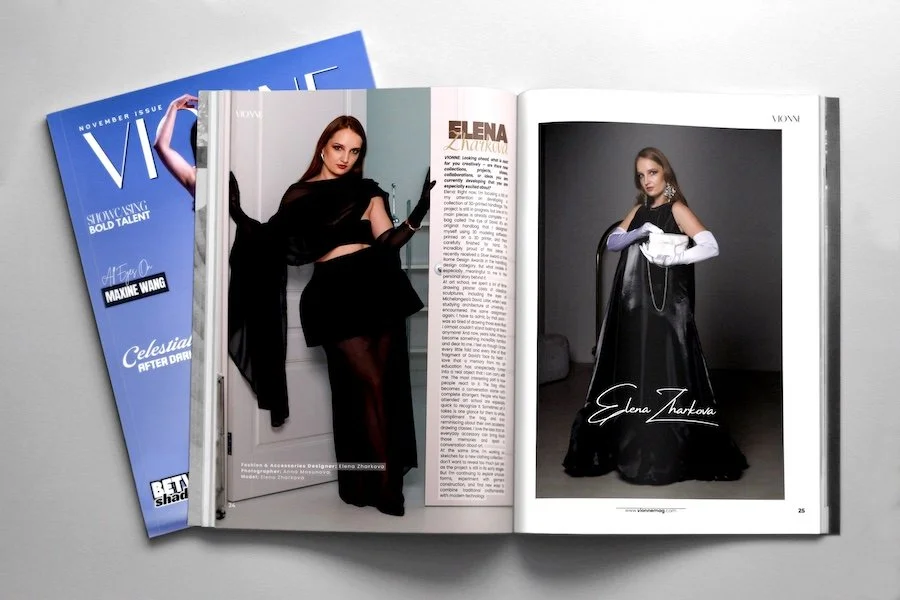
Want more?
Order Issue #19 to discover more powerful stories and explore exclusive features, interviews, and fashion highlights.
Available now online & in print-on-demand.