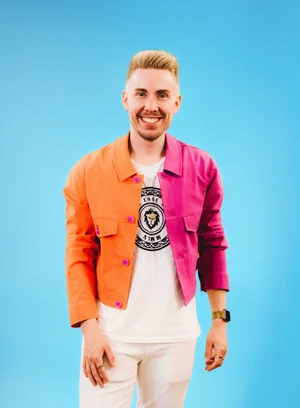
Yasemin Akgül: NO, AMEN! NO, YES!
“My brand was never created to be quiet. It was never created to conform, to ask for permission, or to please everyone.”
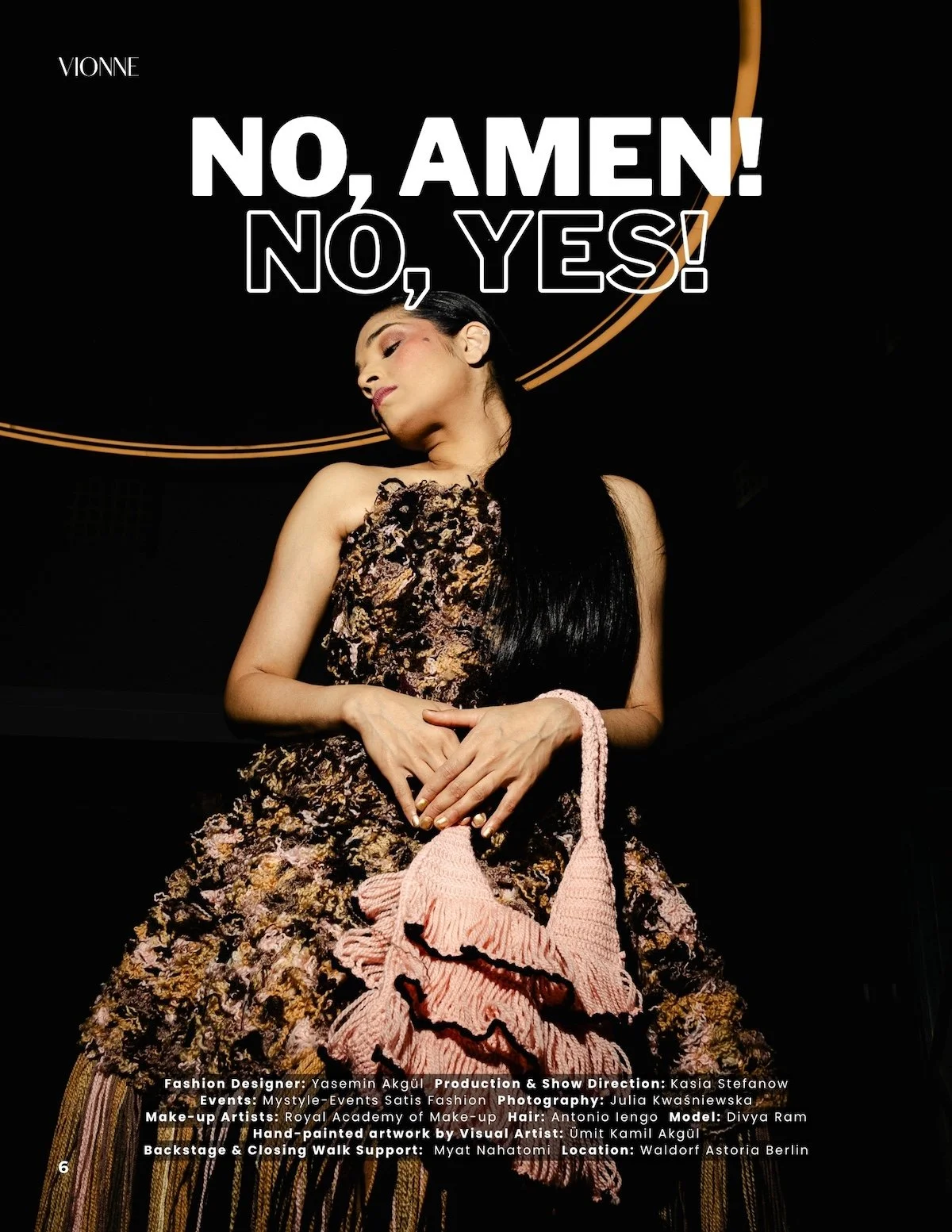
Text: VIONNE Magazine | Fashion Designer: Yasemin Akgül | Production & Show Direction: Kasia Stefanow | Events: Mystyle-Events Satis Fashion | Photography: Rafael Poschmann, Julia Kwaśniewska | Make-up Artists: Royal Academy of Make-up | Hair: Antonio Iengo | Hand-painted artwork by Visual Artist: Ümit Kamil Akgül | Backstage & Closing Walk Support: Myat Nahatomi | Location: Waldorf Astoria Berlin
Couture Refuses Silence
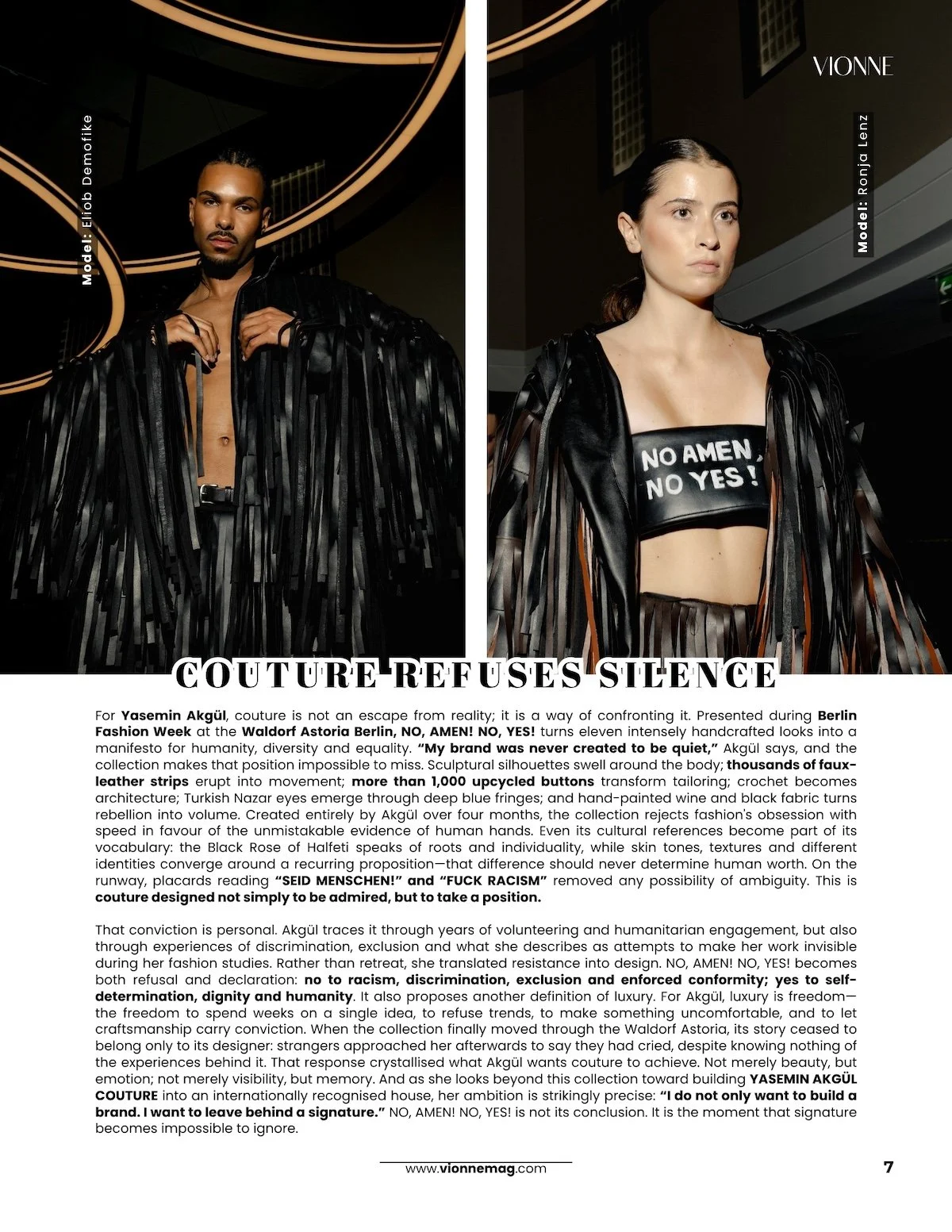
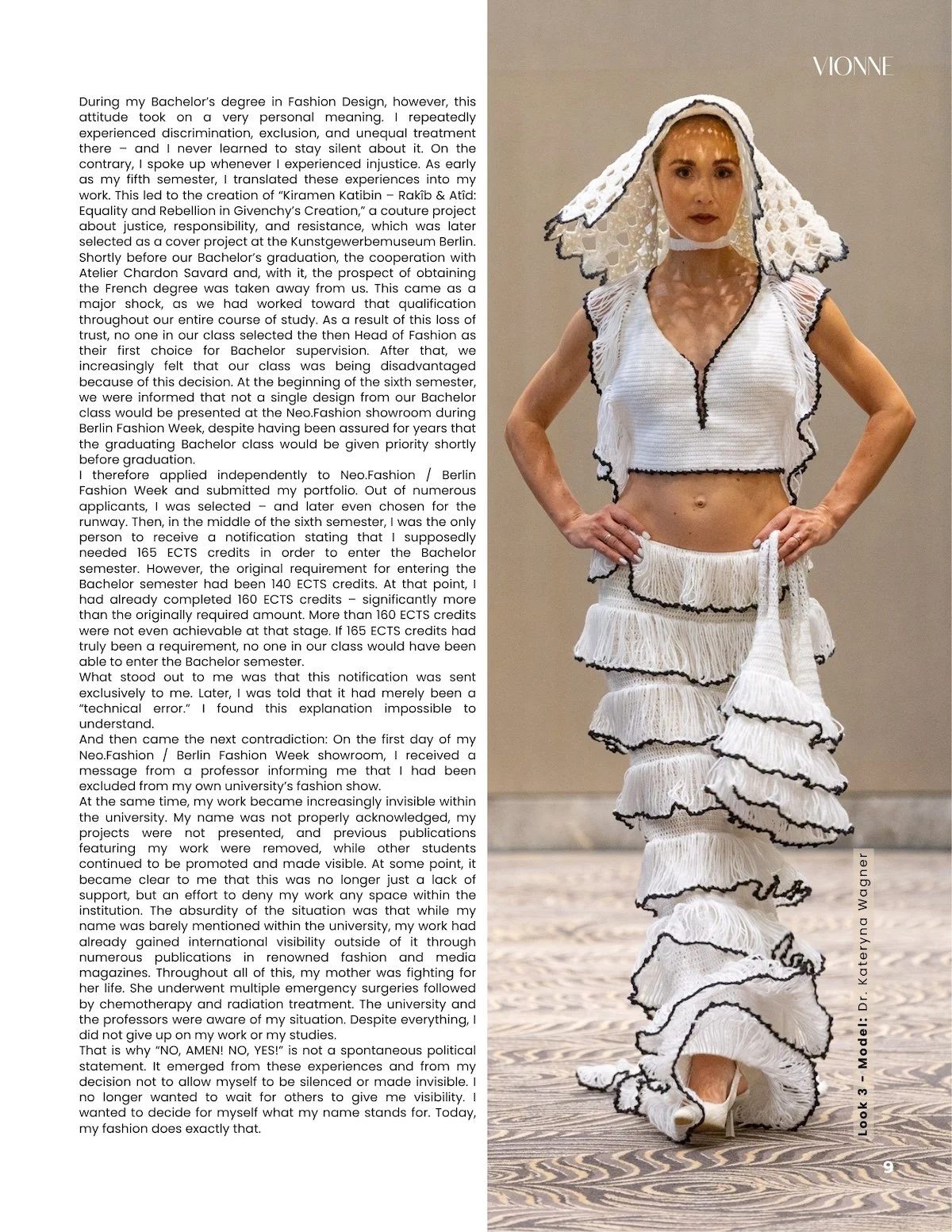
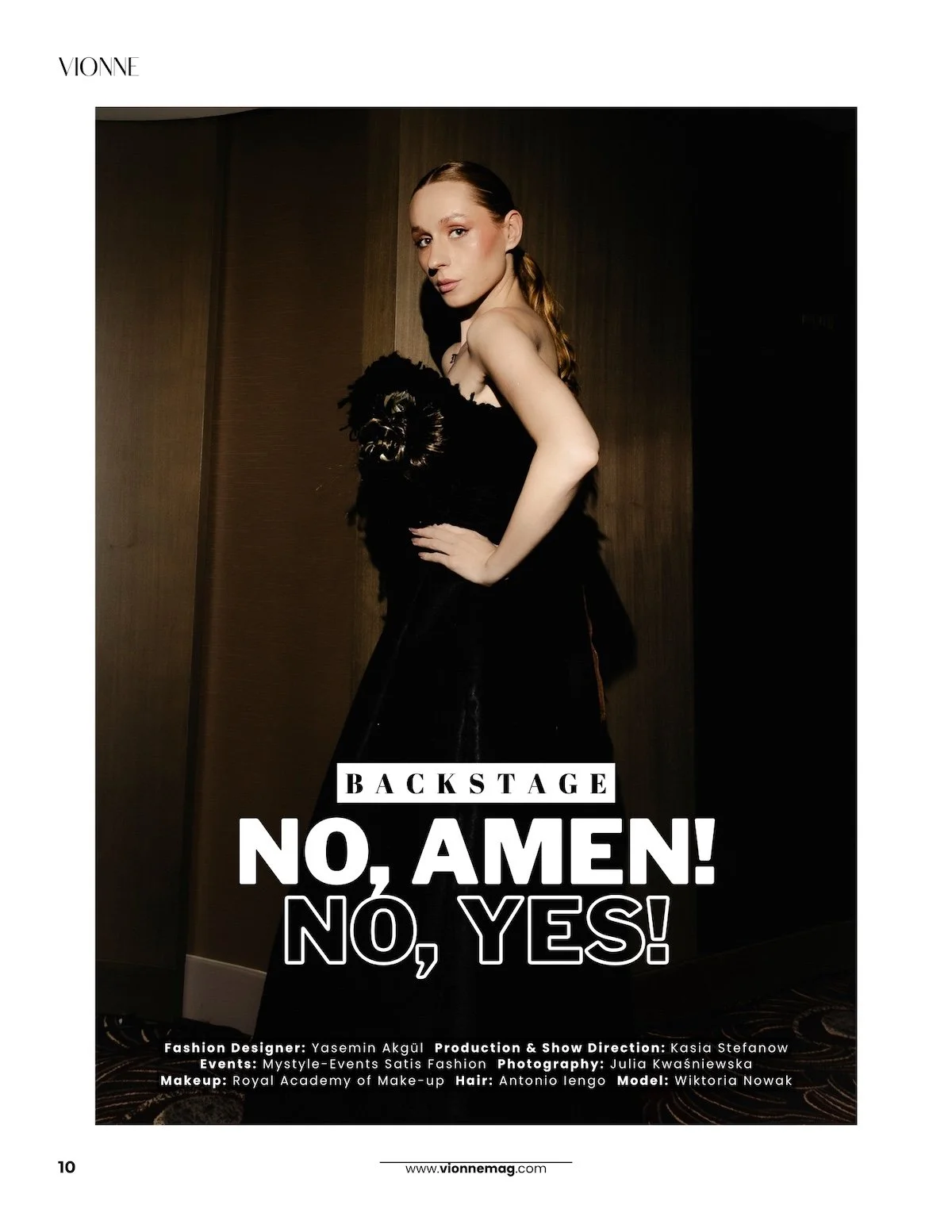
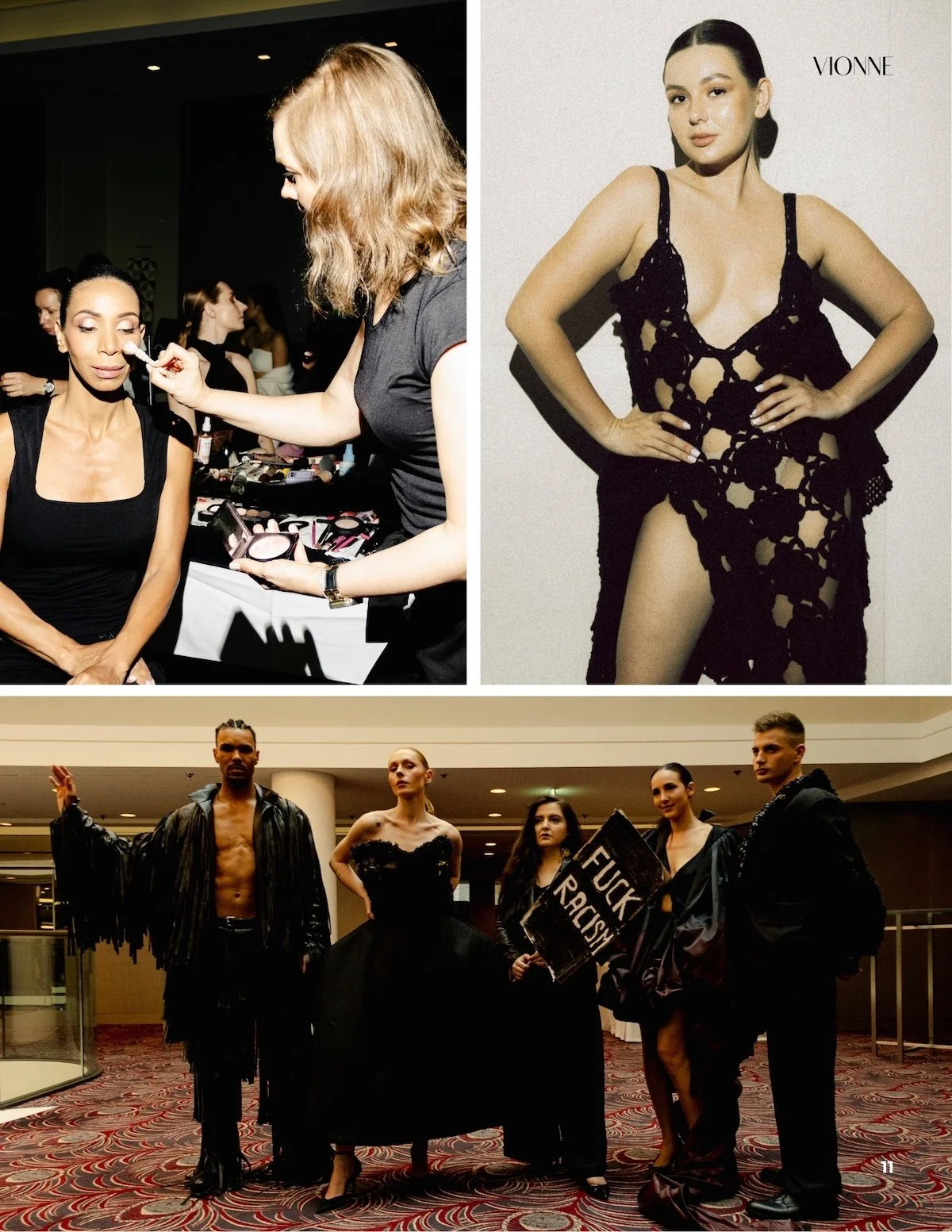
For Yasemin Akgül, couture is not an escape from reality; it is a way of confronting it. Presented during Berlin Fashion Week at the Waldorf Astoria Berlin, NO, AMEN! NO, YES! turns eleven intensely handcrafted looks into a manifesto for humanity, diversity and equality. “My brand was never created to be quiet,” Akgül says, and the collection makes that position impossible to miss. Sculptural silhouettes swell around the body; thousands of faux-leather strips erupt into movement; more than 1,000 upcycled buttons transform tailoring; crochet becomes architecture; Turkish Nazar eyes emerge through deep blue fringes; and hand-painted wine and black fabric turns rebellion into volume. Created entirely by Akgül over four months, the collection rejects fashion's obsession with speed in favour of the unmistakable evidence of human hands. Even its cultural references become part of its vocabulary: the Black Rose of Halfeti speaks of roots and individuality, while skin tones, textures and different identities converge around a recurring proposition—that difference should never determine human worth. On the runway, placards reading “SEID MENSCHEN!” and “FUCK RACISM” removed any possibility of ambiguity. This is couture designed not simply to be admired, but to take a position.
That conviction is personal. Akgül traces it through years of volunteering and humanitarian engagement, but also through experiences of discrimination, exclusion and what she describes as attempts to make her work invisible during her fashion studies. Rather than retreat, she translated resistance into design. NO, AMEN! NO, YES! becomes both refusal and declaration: no to racism, discrimination, exclusion and enforced conformity; yes to self-determination, dignity and humanity. It also proposes another definition of luxury. For Akgül, luxury is freedom—the freedom to spend weeks on a single idea, to refuse trends, to make something uncomfortable, and to let craftsmanship carry conviction. When the collection finally moved through the Waldorf Astoria, its story ceased to belong only to its designer: strangers approached her afterwards to say they had cried, despite knowing nothing of the experiences behind it. That response crystallised what Akgül wants couture to achieve. Not merely beauty, but emotion; not merely visibility, but memory. And as she looks beyond this collection toward building YASEMIN AKGÜL COUTURE into an internationally recognised house, her ambition is strikingly precise: “I do not only want to build a brand. I want to leave behind a signature.” NO, AMEN! NO, YES! is not its conclusion. It is the moment that signature becomes impossible to ignore.
Interview with Yasemin Akgül
VIONNE: “NO, AMEN! NO, YES!” is an intentionally provocative title. What do these four words mean to you personally, and when did you realize they should become the name of the collection?
Yasemin: “NO, AMEN! NO, YES!” is not just the title of a collection. It is the philosophy of my brand. It describes exactly who I am and what YASEMIN AKGÜL COUTURE stands for. My brand was never created to be quiet. It was never created to conform, to ask for permission, or to please everyone. YASEMIN AKGÜL COUTURE follows its own path. At the heart of my brand is politics. My fashion has a voice. And I will not make that voice quieter just to make it more comfortable for others to hear. Political and social issues have been part of my couture from the very beginning. “NO, AMEN! NO, YES!” is therefore not a change of direction, but the natural continuation of that conviction—only clearer and louder. For me, “NO, AMEN!” means refusing to simply say “amen” when people are divided because of their differences. I will never say “amen” to racism, discrimination, exclusion, or injustice. My brand does not distinguish between people based on religion or belief, origin, skin color, gender, or sexual identity. Whether someone is religious or atheist, regardless of where they come from, what they look like, or whom they love—for me, the human being always comes first.
Every person deserves respect, dignity, freedom, and equality. My brand does not stand for a specific group. It stands for humanity. The title is not only directed against social injustice. It is also directed against the idea that fashion must be pleasing, comfortable, or apolitical. The fashion industry often expects conformity. My answer to that is: No. I never founded my brand to chase trends or to please everyone. I founded it to have my own voice.
For me, couture can be more than beauty, luxury, and exceptional craftsmanship. It can make a conviction visible. It can ask questions. It can challenge boundaries. And it can express resistance. The moment I realized that this collection was not only speaking about clothing, but about conviction, resistance, and self-determination, I knew that its name could only be “NO, AMEN! NO, YES!” Because these four words do not only describe the collection. They describe me. I want my work to be recognized not only for its aesthetics, but for what it stands for. A clear conviction. An independent voice. And above all: humanity.
VIONNE: You describe this collection as a statement against racism and for diversity, equality and humanity. Was there a particular experience, observation or moment that made you feel this was something you needed to express through fashion?
Yasemin: Yes. This attitude began long before my studies. Even back then, it was natural for me to help people and to get involved wherever support was needed. I volunteered in aid and donation campaigns, supported refugees by providing food, and advocated for women’s rights. I also helped with earthquake relief efforts in Turkey and humanitarian initiatives for people in Africa – voluntarily, unpaid, and without expecting anything in return.
During my Bachelor’s degree in Fashion Design, however, this attitude took on a very personal meaning. I repeatedly experienced discrimination, exclusion, and unequal treatment there – and I never learned to stay silent about it. On the contrary, I spoke up whenever I experienced injustice. As early as my fifth semester, I translated these experiences into my work. This led to the creation of “Kiramen Katibin – Rakîb & Atîd: Equality and Rebellion in Givenchy’s Creation,” a couture project about justice, responsibility, and resistance, which was later selected as a cover project at the Kunstgewerbemuseum Berlin.
Shortly before our Bachelor’s graduation, the cooperation with Atelier Chardon Savard and, with it, the prospect of obtaining the French degree was taken away from us. This came as a major shock, as we had worked toward that qualification throughout our entire course of study. As a result of this loss of trust, no one in our class selected the then Head of Fashion as their first choice for Bachelor supervision. After that, we increasingly felt that our class was being disadvantaged because of this decision. At the beginning of the sixth semester, we were informed that not a single design from our Bachelor class would be presented at the Neo.Fashion showroom during Berlin Fashion Week, despite having been assured for years that the graduating Bachelor class would be given priority shortly before graduation.
I therefore applied independently to Neo.Fashion / Berlin Fashion Week and submitted my portfolio. Out of numerous applicants, I was selected – and later even chosen for the runway. Then, in the middle of the sixth semester, I was the only person to receive a notification stating that I supposedly needed 165 ECTS credits in order to enter the Bachelor semester. However, the original requirement for entering the Bachelor semester had been 140 ECTS credits. At that point, I had already completed 160 ECTS credits – significantly more than the originally required amount. More than 160 ECTS credits were not even achievable at that stage. If 165 ECTS credits had truly been a requirement, no one in our class would have been able to enter the Bachelor semester.
What stood out to me was that this notification was sent exclusively to me. Later, I was told that it had merely been a “technical error.” I found this explanation impossible to understand.
And then came the next contradiction: On the first day of my Neo.Fashion / Berlin Fashion Week showroom, I received a message from a professor informing me that I had been excluded from my own university’s fashion show.
At the same time, my work became increasingly invisible within the university. My name was not properly acknowledged, my projects were not presented, and previous publications featuring my work were removed, while other students continued to be promoted and made visible. At some point, it became clear to me that this was no longer just a lack of support, but an effort to deny my work any space within the institution. The absurdity of the situation was that while my name was barely mentioned within the university, my work had already gained international visibility outside of it through numerous publications in renowned fashion and media magazines. Throughout all of this, my mother was fighting for her life. She underwent multiple emergency surgeries followed by chemotherapy and radiation treatment. The university and the professors were aware of my situation. Despite everything, I did not give up on my work or my studies.
That is why “NO, AMEN! NO, YES!” is not a spontaneous political statement. It emerged from these experiences and from my decision not to allow myself to be silenced or made invisible. I no longer wanted to wait for others to give me visibility. I wanted to decide for myself what my name stands for. Today, my fashion does exactly that.
VIONNE: How do you translate something as complex as discrimination, identity or human dignity into silhouette, texture, colour and movement?
Yasemin: I do not simply translate these themes into clothing – I give them a form, a voice, and a presence. A silhouette can embody resistance. A texture can carry identity. Color can make heritage, memory, and diversity visible. Movement can become freedom.
I extended this language beyond the garments themselves and onto the runway: Through visual statements such as “FUCK RACISM” and “BE HUMAN!”, as well as representations of different skin tones, the message of the collection became a visible part of the show. But for me, this message does not end with the clothing. The person wearing it is also part of the statement. That is why I consciously worked with models from different cultural backgrounds and identities. Diversity was not meant to be only my message – it was meant to be visible on the runway. Because for me, humanity does not mean being the same. It means being allowed to be different while still having equal value.
That is why couture is more than aesthetics to me. It is a conviction. It is resistance. And it is a voice for humanity.
VIONNE: There is an extraordinary amount of handwork throughout “NO, AMEN! NO, YES!” — from more than 1,000 upcycled buttons and fringes on a tailored collar to thousands of faux-leather strips, and hand-crocheted elements. In an industry increasingly driven by speed, what does spending weeks or even months creating something by hand mean to you?
Yasemin: For me, time is not an effort that needs to be reduced. Time is the foundation of couture. “NO, AMEN! NO, YES!” was created over the course of four months entirely by my own hands. Eleven looks – each one designed, constructed, and crafted by me. None of them are prêt-à-porter. Every single one is couture.
I did not want to create a collection that would be finished as quickly as possible. I wanted to create a collection in which the work can be seen, the time can be felt, and the signature of a human being can be recognized. Thousands of fringes. More than 1,000 upcycled buttons. Hand-crocheted structures. Meters upon meters of fabric and volume. Thousands of hand-cut and hand-sewn faux leather strips. None of it was created at the push of a button. Everything was made by my own hands – step by step.
For me, that is precisely the meaning of couture: not the speed at which something is created, but the depth one is willing to invest in an idea. In an industry that constantly demands faster, more efficient, and more, I consciously choose the opposite. I do not believe in making couture faster. I believe in giving it the time it deserves. Because what is created by hand should not feel interchangeable. I do not want to create couture that is only seen – I want to create couture in which people can feel the time, the hands, and the soul behind it.
VIONNE: Turkish heritage appears through the Nazar eye in LOOK 10, while LOOK 8 explores Afro textures, braids and dreadlocks as the material and structure of couture. How do you approach cultural references responsibly while transforming them into your own contemporary design language?
Yasemin: For me, the responsible use of cultural references begins with respect and an understanding of their meaning. The Nazar Eye in LOOK 10 is part of my Turkish cultural heritage. For me, it represents protection against the evil eye, envy, and negative energy – but also the strength to continue on one’s own path despite all of that and not be influenced by others. That is why I did not use the Nazar Eye as a decorative element, but as a symbol of strength, protection, and self-determination. I wanted to preserve its meaning while translating it into my own contemporary design language.
In LOOK 8, Afro textures, braids, and dreadlocks were not used as decoration, but as material, structure, and form. I am fascinated by their expressive power, their complexity, and the way they create volume, movement, and presence. For me, cultural inspiration does not mean copying something. It means respecting the origin and significance of a reference and consciously bringing it into a new creative context. Fashion can connect different stories—as long as it does so with respect, awareness, and appreciation.
VIONNE: “SEID MENSCHEN!” — “BE HUMAN!” — is one of the collection’s most direct messages. Do you believe designers have a responsibility to take a position on the world around them?
Yasemin: “SEID MENSCHEN!” — “BE HUMAN!” is, for me, the strongest message of this collection. I associate these words with Margot Friedländer, a woman for whom I have the deepest respect and admiration. Her story, her attitude, and above all her tireless reminder never to lose our humanity have profoundly moved me.
For me, “BE HUMAN!” is therefore far more than a phrase. It is a reminder that we must never hide behind origin, skin color, religion, or identity when it comes to recognizing the value of another human being. We are different. We have different stories, cultures, and experiences. But no difference makes one person worth less than another. I did not want these words to appear only on a garment. I wanted them to become part of the entire show—as a visible statement and as the conviction behind the collection.
“BE HUMAN!” means to me: Be different. Be yourself. But never lose your humanity. That is the message I want to leave behind with this collection.
VIONNE: You presented the collection during Berlin Fashion Week at the Waldorf Astoria Berlin. What did it feel like to watch months of intensely personal work become a live statement in front of an audience?
Yasemin: It was one of the most emotional moments of my life. For four months, I developed and created this collection entirely on my own. During that time, a collection exists only within your own universe—between fabrics, sketches, dress forms, doubts, and countless hours of work. You live with each individual look for so long that, at some point, you no longer know how it will affect other people. It was only on the runway at the Waldorf Astoria that my vision truly came to life. My family, close friends, colleagues, and people from my creative circle were deeply emotional. Some cried and were incredibly proud of me. That, of course, touched me profoundly—because they know my journey, they have witnessed my work over the years, and they understand how much strength, time, and dedication went into this collection. They also know about the difficult experiences I went through during my studies and the experiences of exclusion that shaped my path. But there was something that affected me even more: the reactions of people I had never met before.
After the show, photographers, models, designers, and other creatives came up to me personally and told me how deeply the show had moved them. Others wrote to me later on Instagram. They told me that they had cried, that the message had touched them deeply, and that they had felt something in the collection that they had not expected. These people did not know my story. They did not know how this collection came into being, what I had experienced on my journey, or how many hours and how much strength stood behind it. And yet, it still triggered something within them. That touched me deeply in my heart. Because in that moment, I realized: My work can reach people without them knowing me or my journey.
That is exactly why I create couture. Not only to show something beautiful, but to evoke something—a feeling, a thought, perhaps even a memory. For four months, this collection was my story. On that runway, it began to touch other people as well and to tell its own story. And that, for me, is the true power of fashion.
VIONNE: Your collection rejects the idea of creating to conform, please or follow trends. In your eyes, what defines true luxury today — perfection, craftsmanship, individuality, emotional impact, or something different?
Yasemin: For me, true luxury today does not mean perfection in the classical sense. True luxury is freedom. The freedom to develop your own language. The freedom not to have to please everyone. The freedom not to follow every trend. In a world where fashion is produced and consumed faster than ever, it is a luxury for me to give an idea the time it deserves. “NO, AMEN! NO, YES!” was created over the course of four months entirely by my own hands. Eleven looks – none of them prêt-à-porter. Every single one couture.
Thousands of fringes, hand-crocheted structures, meters upon meters of fabric and volume, more than 1,000 upcycled buttons, and countless handmade details are not simply embellishments to me. They make the time and dedication behind each look visible. But for me, couture does not end with technical perfection. It has to evoke something. It has to leave something behind in a person. It is allowed to ask questions. It is allowed to be uncomfortable. It is allowed to carry a conviction.
I do not want to create couture that only looks beautiful. I want to create couture that people see, feel, and do not forget so easily. For me, that is true luxury: the freedom to be different, the time to create something unique, the ability to remain true to your own vision, and the courage to turn that vision into a conviction.
VIONNE: After a collection this intensive, where do you go next? What do you want the next chapter of YASEMIN AKGÜL COUTURE to explore, and what is the dream you are still determined to turn into reality?
Yasemin: I do not see “NO, AMEN! NO, YES!” as an ending, but as a beginning. This collection has shown me how far I can carry my vision – and at the same time, how much still lies ahead of me.
In the next chapter, I want to further develop my couture, explore new materials and extraordinary silhouettes, and push the connection between fashion, art, craftsmanship, and social conviction even further. My goal is to build YASEMIN AKGÜL COUTURE into an internationally recognized couture brand with a distinctive signature, its own world, and a clear point of view.
My greatest dream is not simply a bigger show or a bigger name. I want to create a couture world that belongs only to me. A world in which every piece carries my signature, where craftsmanship never becomes secondary, and where couture is allowed to be more than aesthetics.
I was not given a ready-made path. I built my brand myself – without a PR agency, without a large team, and without a predefined roadmap.
What exists today is the result of countless hours of work, discipline, setbacks, perseverance, and above all, a strong belief in my own vision. None of it was handed to me. I earned my path myself – with my own hands. And that is exactly why I know: I am still far from my destination. I do not only want to build a brand. I want to leave behind a signature.
One that people recognize before they read my name. One that does not adapt simply to be accepted. One that has the courage to be different and to preserve its own conviction. For me, “NO, AMEN! NO, YES!” is therefore not the end of a collection. It is the statement with which I begin my next chapter. I built my vision with my own hands. Now begins the next fight to see how far it can go.
Extended Credits:
Make-up Artists:
Royal Academy of Make-up / Instagram: @royal_academy_of_makeup
Stella Grossu / Instagram: @stellagrossu
Anna Bohuslavska / Instagram: @anna_bohuslavska
Nina Zhorzholiani / Instagram: @kakauridzenini
Ivanna Kamenshchykova / Instagram: @ivannakam
Iryna Golovchenko / Instagram: @irynagolovchenko
Karchenkova Oleksandra / Instagram: @karchenkova_make_up
MODELS:
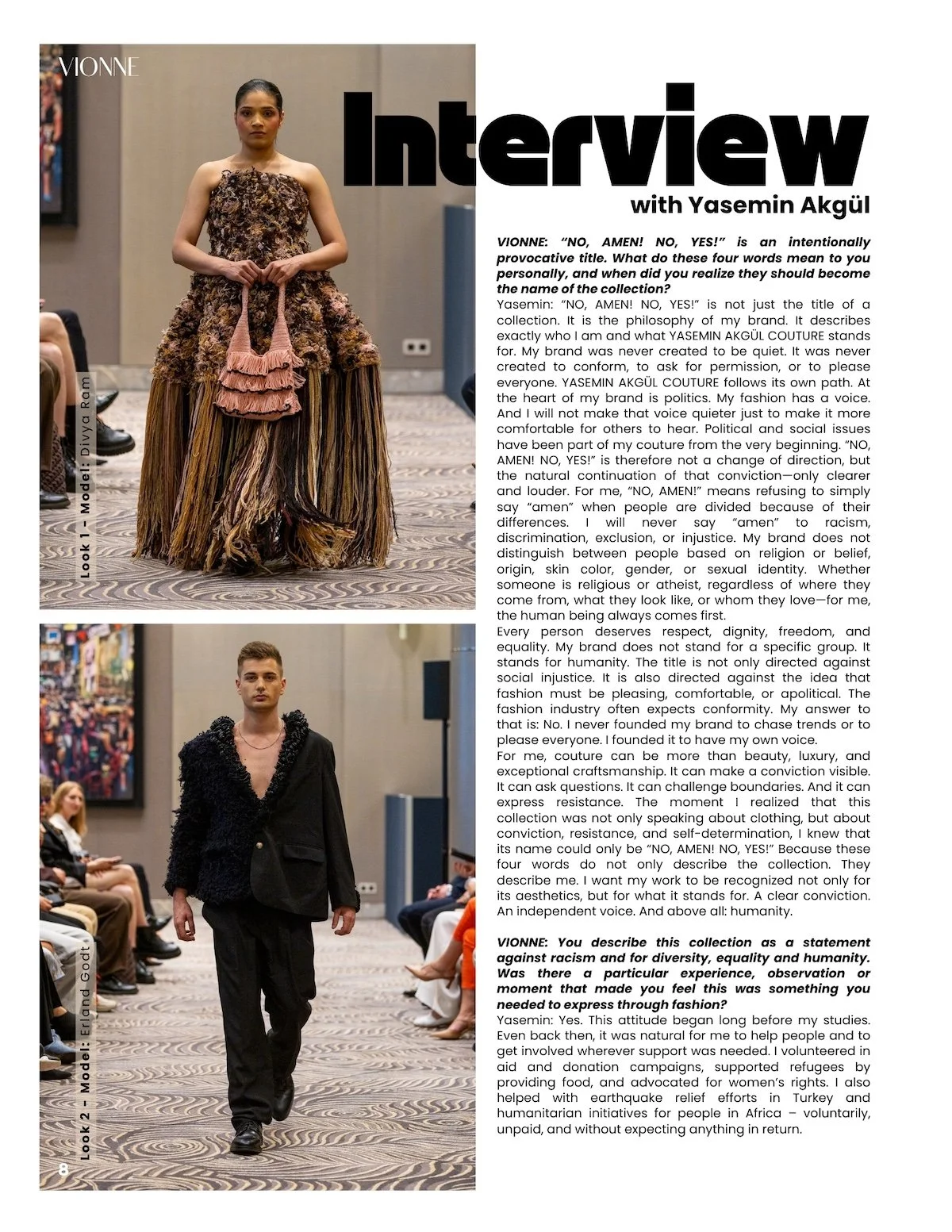
LOOK 1: Model: Divya Ram / Instagram: @div_fashionmodel
LOOK 2: Model: Erland Godt / Instagram: @3rlxnd
LOOK 3: Model: Dr. Kateryna Wagner – Reigning Mrs. Germany / Instagram: @kateryna.wagner
LOOK 4: Model: Ronja Lenz / Instagram. @ronjalnz
LOOK 5: Model: Wiktoria Nowak / Instagram: @wrnowak
LOOK 6: Model: Helena Van De Kasteele / Instagram: @helena_van_de_kasteele
LOOK 7: Model: Olga Borys / Instagram: @itsolgaborys
LOOK 8: Model: Uchenna Zoé / Instagram: @uchenna.zoe
LOOK 9: Miriam Nematijou / Instagram: @drea_my_miri_
LOOK 10: Cindy Koopmans / Instagram: @cindy.koopmans
LOOK 11: Eliob Demofike / Instagram: @_eliobx
Want more?
Order Issue #17 to discover more powerful stories and explore exclusive features, interviews, and fashion highlights.
Available now online & in print-on-demand.