Helena Barbagelata: Song of the Siren
“The past is not a shadow; it is a springboard—giving the present its depth and the future its shape.”
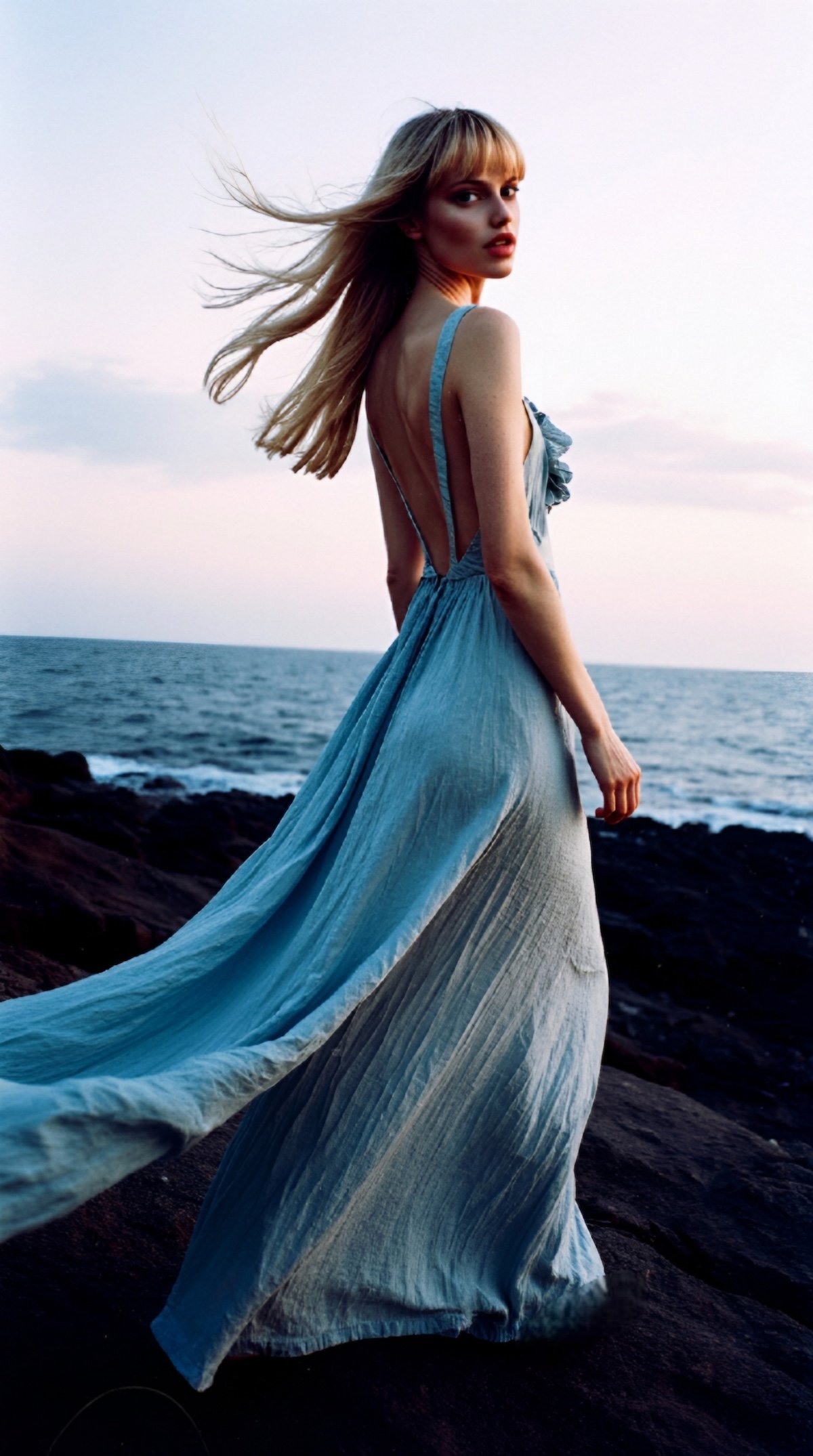
Text: VIONNE Magazine | Model: Helena Barbagelata | Agency: IntownModel Management
Photographer: Stefano Novarese | Creative Director: HD Productions
Fashion & Accessory Designer: Atelier Emé | Stylist/Makeup Artist/Hair Stylist: Vittoria Solaro
Where Fashion Meets Fine Art
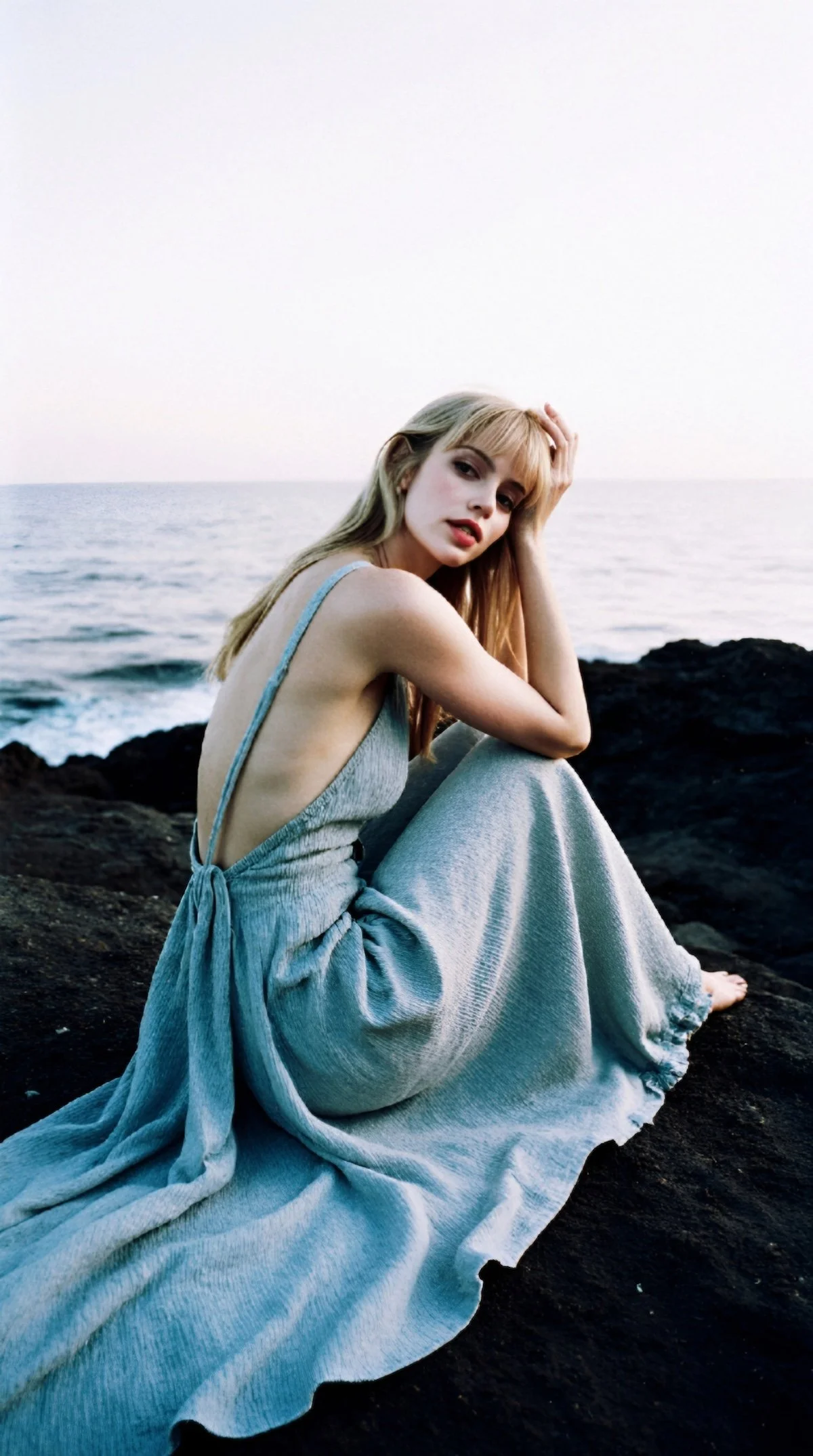
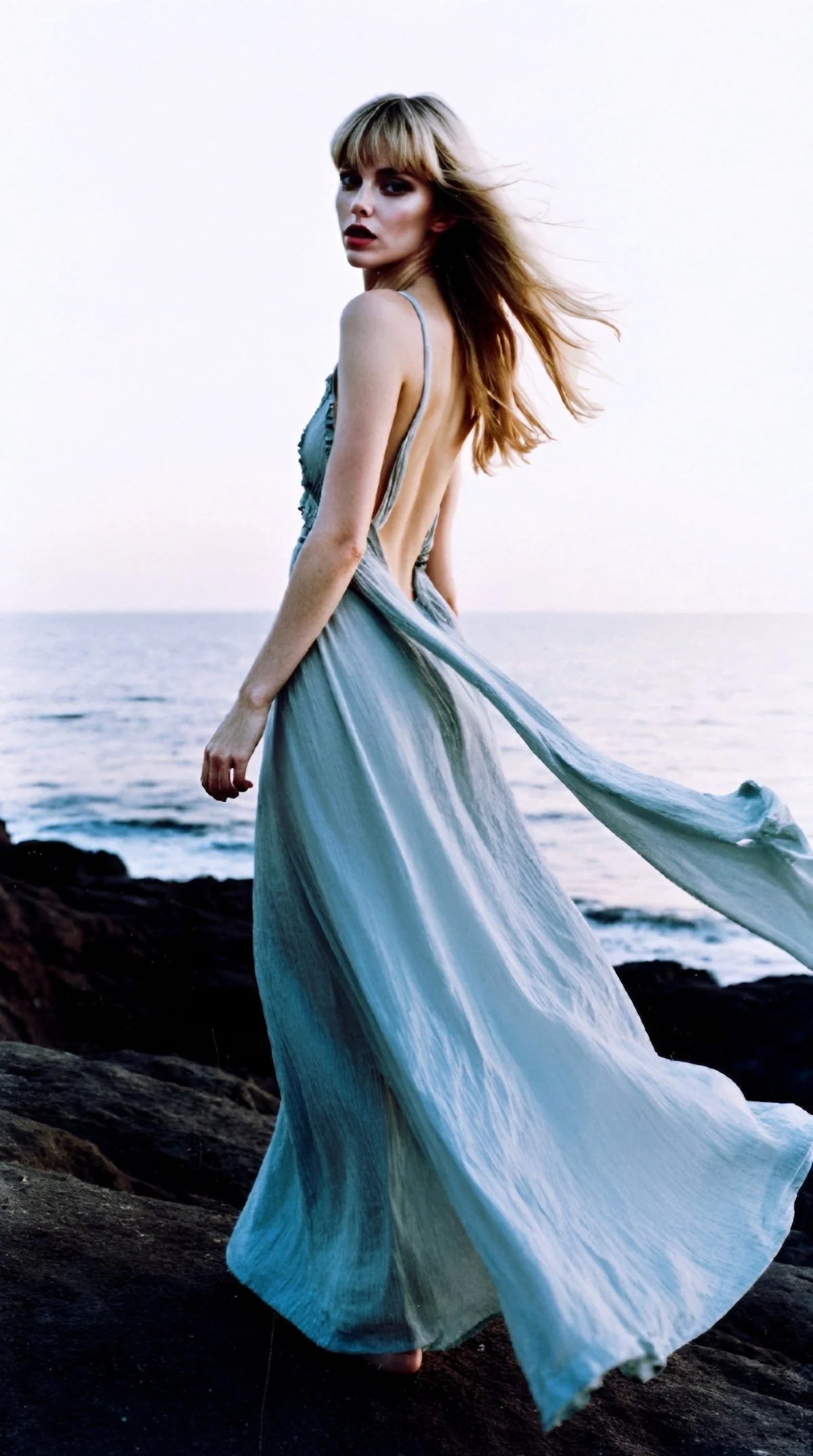
Rising from the liminal space between myth and modernity, Song of the Siren presents Helena Barbagelata as a contemporary embodiment of Venus—fluid, sculptural, and quietly magnetic. Set against the elemental dialogue of sea and stone, the editorial channels Northern Italy’s Renaissance legacy through a distinctly modern lens. Photographer Stefano Novarese captures Helena not as a static muse, but as a living presence shaped by movement, breath, and intuition. Each frame unfolds like a fresco in motion, where couture silhouettes echo the softness of waves and the enduring elegance of classical form.
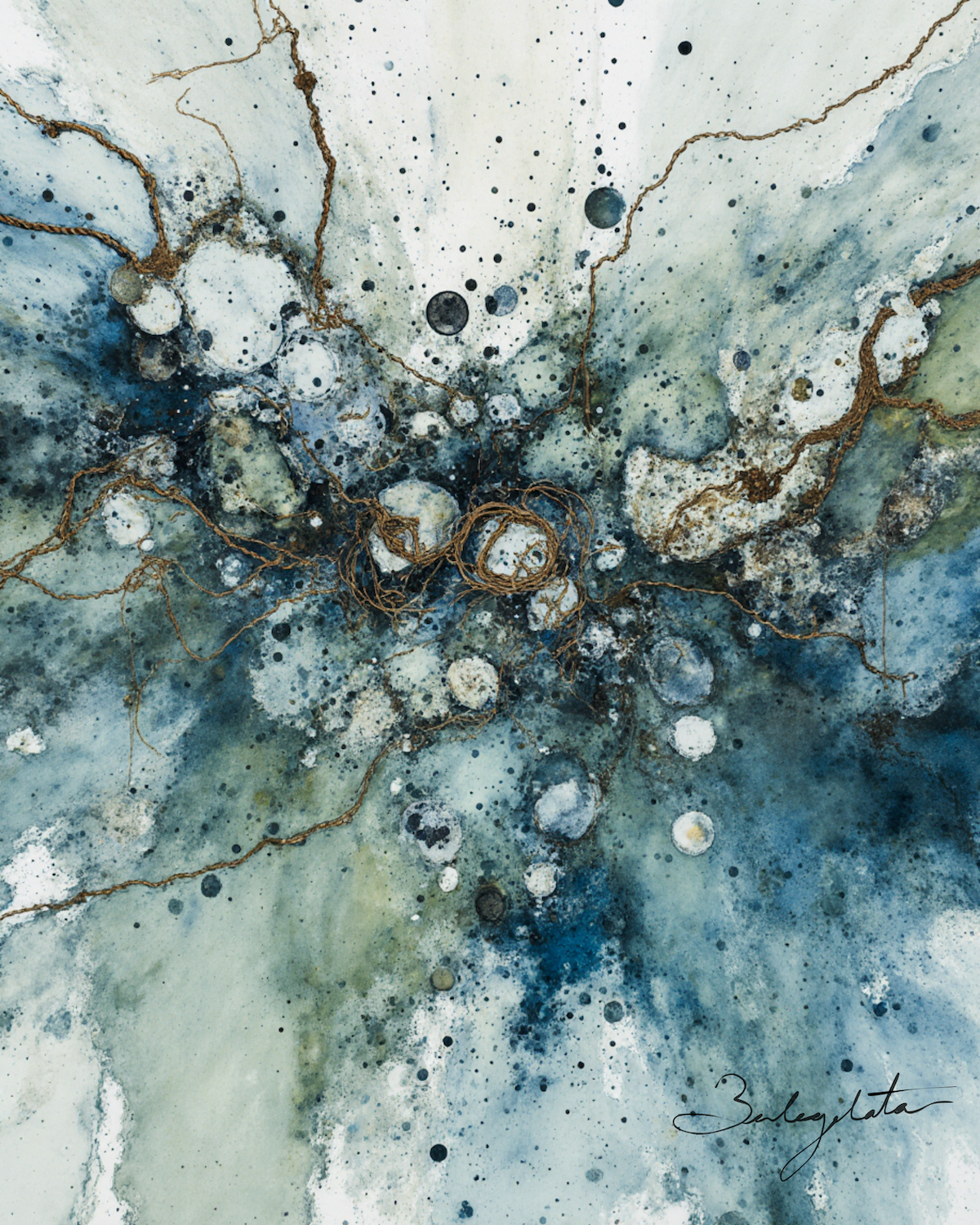
Beyond the images, Song of the Siren deepens into a rare convergence of fashion and fine art. Helena contributes three original mixed‑media works, allowing her artistic practice to converse directly with her modeling. This dual authorship transforms the editorial into a layered narrative of metamorphosis—where body, fabric, memory, and myth intertwine. Rooted in history yet unmistakably forward‑looking, the story becomes a meditation on identity, place, and the power of imagery to linger long after the page is turned.
Interview with Helena Barbagelata
VIONNE: “Song of the Siren” draws heavily from myth and the idea of Venus rising from the sea. How did you personally connect to this narrative while embodying it on set?
Helena: To embody the editorial concept was to step into a visual myth, where every moment feels composed like a Renaissance fresco. Northern Italy is profoundly connected to this ideal: Botticelli’s muses were drawn from the faces of the north. This Genovese phenotype became a painterly archetype and it helped shape the gentle beauty of Botticelli’s Venuses and Spring figures. On set, I tried to embody the feeling of the landscape itself: limestone cliffs, salt breath, the horizon in deep blue. The dresses, beautifully crafted in Liguria, were inspired by these Renaissance silhouettes and textures, designed to restore the softness and flowing elegance of the paintings. The directors had this concept clearly in mind, and it informed every choice. Novarese, our photographer, encouraged me to be «a mio agio», completely at ease, and he followed my movements with a fluid, intuitive approach, letting the camera translate each gesture naturally. There were moments when I could simply walk, turn, or raise an arm, and the image felt born rather than staged. It was a collaboration of intuition, place, and history.
VIONNE: The images feel fluid, sculptural, and almost timeless. What emotions or inner states were you tapping into during the shoot to achieve this sense of quiet allure?
Helena: Before a shoot, I like to inhabit the concept and the location fully, to feel the place in my body as much as in my mind. In this case, I let the sea guide me: the gentle swell of waves, the smell of salt in the air, the smooth texture of rocks under my fingers, the soft early light on the water. I focus on my breath, letting my body expand with the openness of the horizon, absorbing the colors, the rhythm, the subtle energy of the environment. That feeling of softness and freedom, the way the sea moves without effort, how it stretches and curves endlessly, becomes a sensation I can carry into posture, gaze, and gesture. I draw on classical references to channel that internal state visually: the calm, poised elegance of Raphael’s serene portraits, where softness conveys grace and presence; the sculptural lines of Bernini, where bodies feel alive in their own space; and Visconti’s cinematic compositions, where every frame holds the weight of emotion and atmosphere. The emotion I aimed to convey is layered, serenity, openness, and subtle longing, a sense of being fully present while simultaneously dissolving into the space around me.
VIONNE: Who or what has influenced you most along your journey so far—are there artists, models, or moments that shaped how you see yourself within fashion today?
Helena: My references are both art historical and visual cultural, from Renaissance ateliers to Transavanguardia’s postmodern reinventions, taught me that identity lives in how you see, not just what you wear; artists such as Mimmo Paladino, Francesco Clemente, and Enzo Cucchi, blend myth and immediacy, suggesting that art’s relevance is in its emotional charge. I also study cinema and photography as image language, Barbieri and Rovesi's textured mise‑en‑scène, Viviane Sassen's contrasts and colors, Pietrangeli's cultivated stillness between movements, Ermanno Olmi's use of space and absence and the austere compositions of Pasolini. I look at models such as Marion Morehouse, whose collaboration with Edward Steichen married modernism and fashion in the 1930s, transforming the model from object to auteur subject. And I think of Dovima under Avedon’s lens, where fashion becomes sculpture in light, a quiet insistence that the body inhabits an image instead of showing it, among so many other references.
VIONNE: You contributed three original artworks to this story, creating a rare dialogue between fashion and fine art. How does your artistic practice influence the way you move, pose, or think in front of the camera?
Helena: In my studio, working with canvas or material is like composing a sequence of gestures, the same way a dancer thinks in phrases, not steps. That mindset carries into my modeling: I think in movement arcs and emotional inflections. My practice in paint and drawing also refines my kinesthetic sense: how the tilt of a rib, the arch of a wrist, can shift an image’s center of gravity. I also think in layers, as in painting, where underpainting, glaze, and shadow interact to create depth, I consider the layering of gestures, gaze, and breath. A subtle turn of the head can become a horizon line; the interplay of shadow and contour can feel like chiaroscuro sculpted in air. Modeling becomes a form of embodied composition, where the body is simultaneously subject and instrument, a living medium for light, space, and narrative.
VIONNE: Your work “Figura di Marea I” speaks of water, memory, and transformation. Do you see modeling as a similar process — one of constant metamorphosis?
Helena: Yes, both modeling and water are forms in motion. Modeling repeatedly asks you to reconstruct yourself, not as copies of an ideal, but as incarnations of image and feeling. Like tides that leave new patterns in sand, each shoot reshapes what came before. I often think of the woman in silent cinema whose face carries entire narratives without dialogue, motion, memory, metamorphosis in one gaze. That’s the kind of visual choreography I aim for: image as transformation, not replication.
VIONNE: As an Italian model rooted in a rich cultural and artistic heritage, how important is it for you to bring history, place, or identity into contemporary fashion narratives?
Helena: It’s vital. History is not nostalgia, it is the texture of seeing. Italian culture taught me that image comes already woven with place, the cadence of poetic language. This composes a visual rhythm that I carry into fashion imagery, not as a costume, but as spirit in frame. But tradition is not a fixed point, it is a foundation for the future. The lessons of classical art, Renaissance balance, and the avant‑garde cinematic vision of Italy’s maestros become tools to imagine new narratives, to create fashion imagery that feels alive and forward-looking. I approach each image as a conversation between past and present, allowing history to guide the feeling, the composition, and the emotion, while pushing toward what has yet to be seen. The past is not a shadow; it is a springboard, giving the present its depth and the future its shape.
VIONNE: In your view, what separates a visually beautiful image from one that truly lingers in the viewer’s mind?
Helena: A beautiful image pleases the senses; a lingering image resonates with memory, emotion and myth. It is not just form or hue, it is tension and implication. Iconic fashion photography, from Horst’s sculptural compositions like the “Mainbocher Corset” to the experimental portraits that transformed fashion into visual poetry, lodges itself in the imagination because it carries reference, risk, and subtle narrative. A lingering image is one that makes the viewer return, not to look again, but to feel again.
VIONNE: Looking ahead, what creative directions, collaborations, or personal projects are you most excited to explore next — both in fashion and in your art?
Helena: I’m drawn to projects at the intersection of art, fashion, and film; where clothing, movement, and image are treated not as separate disciplines but as parts of a single expressive language. Working with directors and photographers who blur these boundaries excites me: those who see garments as characters, light as emotion, and composition as storytelling. In my own visual art, I explore similar ideas, metamorphosis, transformation, and the poetry of form. I aim to create images that feel alive, where shape becomes emotion, movement conveys thought, and each image opens doorways for the viewer rather than providing definitive answers and every frame feels like a moment suspended between past tradition and future possibility.
Follow Helena Barbagelata | IntownModel Management
Want more?
Discover more powerful stories and explore exclusive features, interviews, and fashion highlights.