“Reinvention is not becoming someone else. It is becoming large enough to contain everything you have learned.”
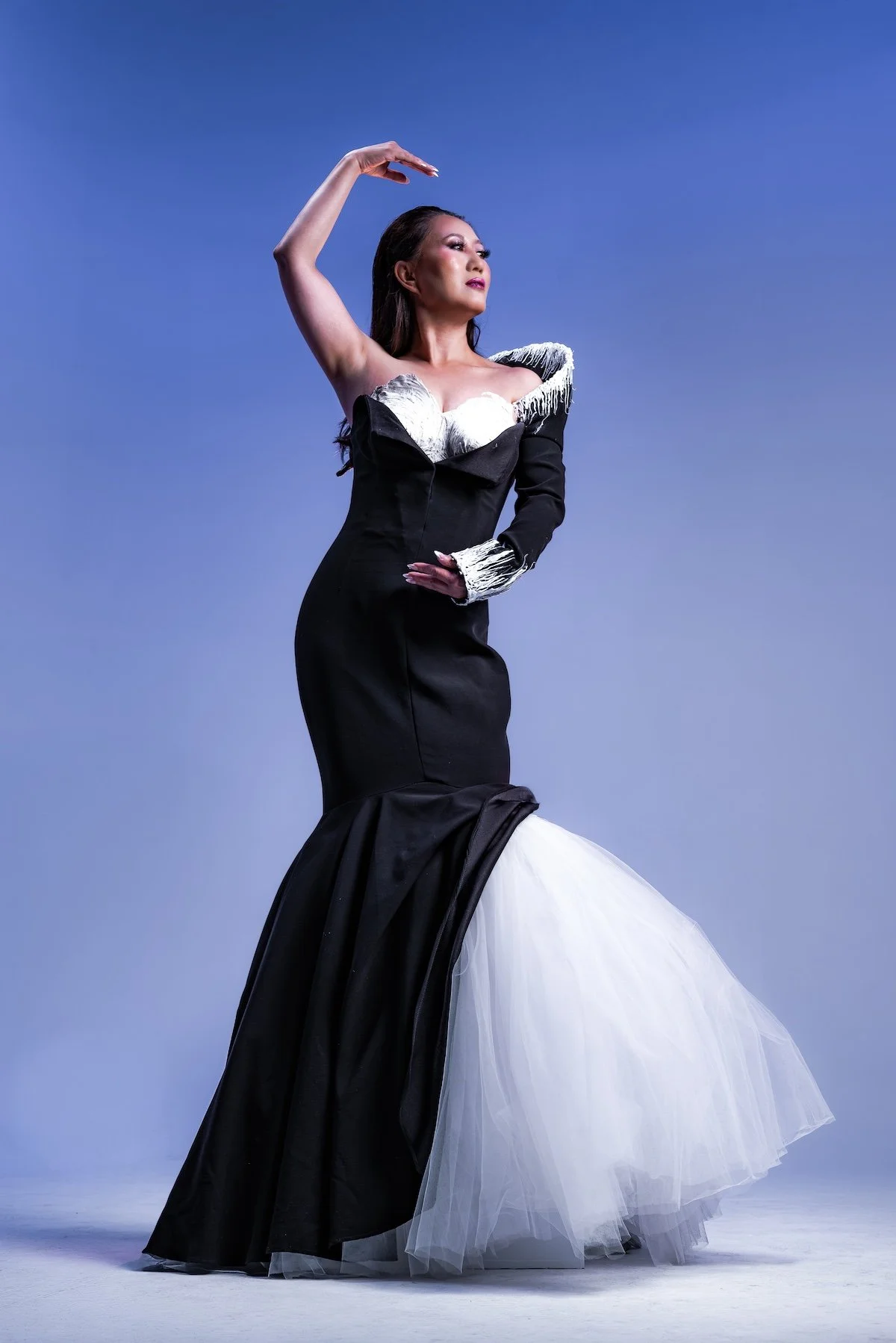
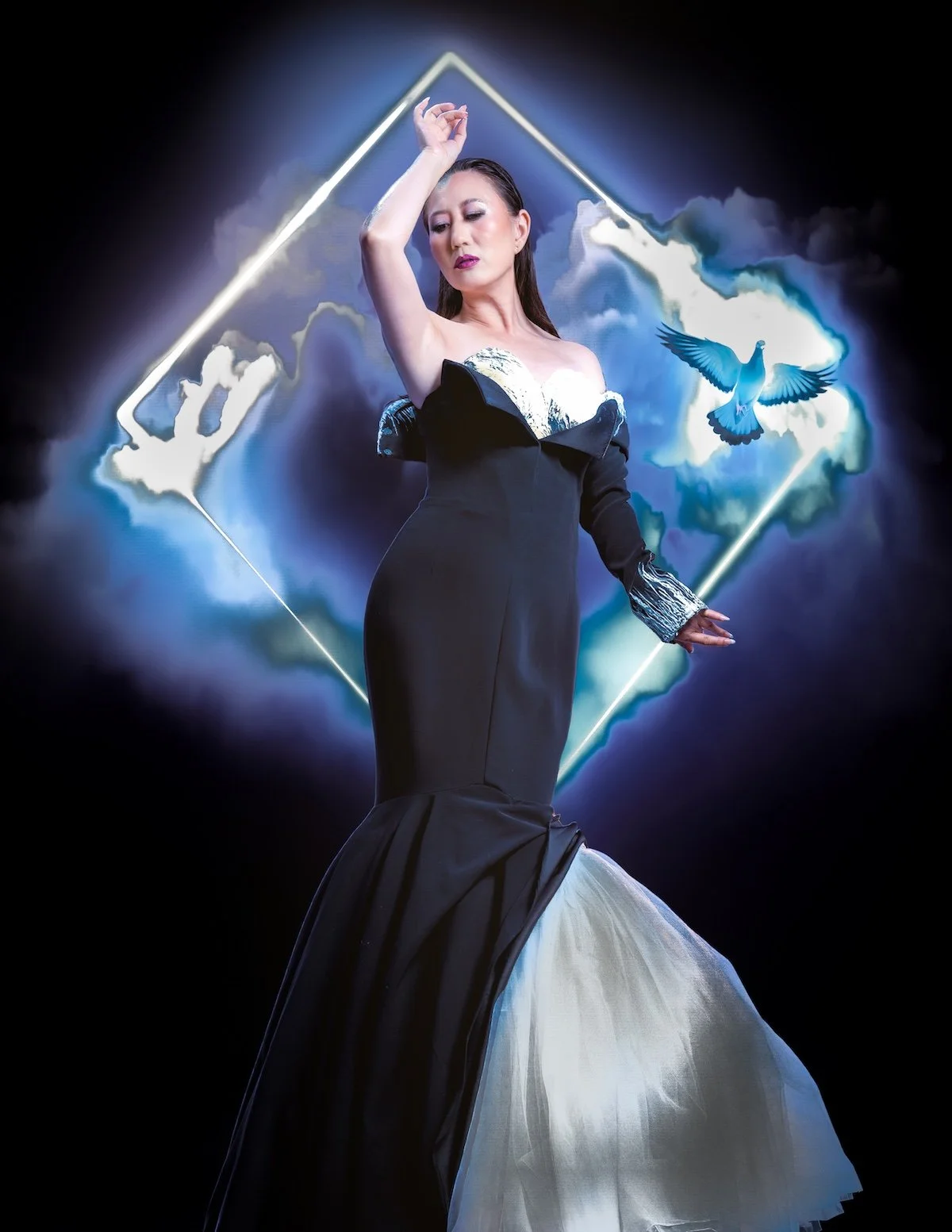
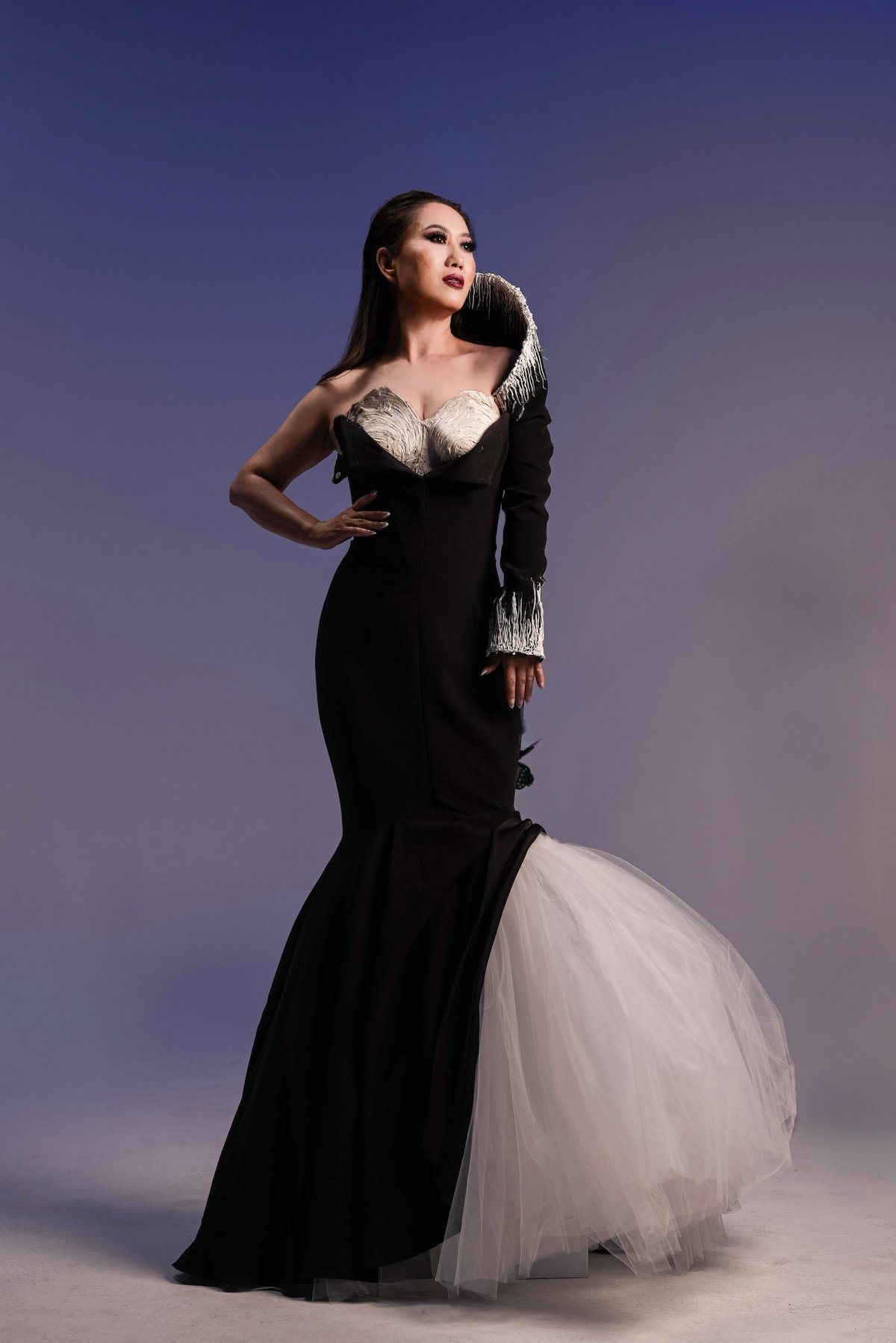
Text: VIONNE Magazine | Model: Maxine Wang | Photographer: Alex Rea | Makeup Artist: Miguel Arroyo | Fashion Designer: Tamara Nasr
Beauty Beyond the Surface
Celestial Noir places Maxine Wang inside a world suspended between darkness and illumination. Sculptural black couture by Tamara Nasr is cut through with ivory volume, creating a silhouette that feels at once severe, romantic, and almost otherworldly. Photographed by Alex Rea, with makeup by Miguel Arroyo, the series explores the tension between strength and softness through controlled movement, dramatic posing, and an icy celestial atmosphere. The contrast feels particularly fitting for Wang, whose own life moves across seemingly different worlds — technology, entrepreneurship, fashion, and visual storytelling — disciplines she sees not as separate identities, but as interconnected ways of understanding imagination, creation, and human experience.
That sense of transformation runs beneath the images. Wang describes reinvention not as abandoning the person you were, but as expanding enough to contain everything you have learned. Her philosophy of a “living legacy” similarly rejects the idea that meaning begins only after a life is over; for her, legacy is built continuously through curiosity, courage, creativity, and evolution. In Celestial Noir, those ideas become visual: darkness does not erase softness, and elegance does not cancel strength. Instead, opposites coexist — much like Wang’s own fascination with the point where beauty, accomplishment, transformation, and meaning begin to connect.
Interview with Maxine Wang
VIONNE: Your life and work span technology, entrepreneurship, fashion, and creative expression. What connects these different dimensions for you?
Maxine: For me, they have never really been separate. They may appear unrelated from the outside, but each has given me a different way of understanding the world. Technology taught me to understand change and possibility. Entrepreneurship taught me how ideas become reality—and how much vision, discipline, judgment, resilience, and courage that requires.
Fashion and modeling introduced another vocabulary: beauty, form, movement, emotion, identity, and visual communication. They also brought me into close contact with designers, photographers, artists, and other creative people who can take something that exists only in their imagination and give it physical form. That process fascinates me. Someone imagines a silhouette that has never existed. Someone understands light in a way I don't. Someone sees a face, a movement, a piece of fabric, or a location and transforms it into something emotionally powerful.
When you experience enough different worlds, you begin to see connections that were invisible before. It is almost like collecting pieces of a very large puzzle. Eventually, you are no longer simply learning about technology, business, fashion, or art. You are learning about human beings—what we imagine, what we create, what we value, and what makes a life feel fully lived.
VIONNE: Reinvention is central to your philosophy. What does reinvention mean to you?
Maxine: I don't see reinvention as rejecting your past and becoming someone new. I see it as expansion. Every stage of life gives us knowledge, but knowledge can become a limitation if we begin believing that what we have already mastered defines the boundaries of who we are.
I have always been attracted to the edge of what I don't yet understand—the next industry, the next era, the next way of thinking. That requires challenging assumptions that may once have made you successful. But transformation requires exactly that. The purpose is not endlessly to change identities. It is to accumulate dimensions.
Eventually, the pieces begin connecting: technology, entrepreneurship, art, fashion, culture, human behavior. You begin to understand that none of the experiences were isolated. Reinvention is not becoming someone else. It is becoming large enough to contain everything you have learned.
VIONNE: You speak about legacy differently from the traditional idea of leaving something behind. What is your philosophy of legacy?
Maxine: I think we have made legacy too retrospective. We often talk about it as though it begins when life ends: What will people remember about me? What did I leave behind? My question is different: What are you doing with the life you still have?
To me, legacy is alive. It is being created through our choices, transformations, relationships, knowledge, courage, creativity, and experiences. Accomplishment matters. But accomplishment without continued evolution can eventually become simply a record of what you once did. A meaningful life should continue unfolding.
That is why I don't think legacy is primarily about being remembered. It is about living in a way worth remembering. That distinction became part of the intellectual foundation behind LEGACIQ.
VIONNE: Beauty has remained a powerful thread throughout your life. What are you seeking through fashion and creative expression?
Maxine: Beauty has always affected me deeply. But I don't mean beauty simply as something visually attractive. What fascinates me is the human ability to create beauty where it did not exist before. A designer begins with an idea and transforms it into form. A photographer transforms light into emotion. An architect transforms space. A musician transforms silence. An entrepreneur can take something that exists only in the imagination and build it into reality.
Different disciplines, but there is something profoundly similar happening underneath them. There is imagination, followed by creation. Through fashion, I have had the opportunity to experience that process from inside the image—to understand the relationship between the designer's vision, the photographer's eye, the model's interpretation, the environment, and the final moment that is captured.
What interests me increasingly is the relationship between beauty, creation, accomplishment, and a fulfilled life. Beauty may attract my attention, but I want to know what exists behind it. What did someone have to imagine, learn, sacrifice, experience, or understand in order to create something extraordinary? I am interested not only in beautiful things. I am interested in the human capacity to create beauty and meaning.
VIONNE: Has your understanding of what makes a meaningful life changed as you have moved through different stages of your own?
Maxine: Completely. When I was younger, I probably would have called much of what drove me ambition. There were companies to build, goals to reach, problems to solve, and accomplishments that could be measured. I don't reject that period of my life. It taught me enormously, and the instinct to build and create remains part of who I am.
But over time, the question changed. It became less about How much more can I achieve? and more about How much more can I understand? How deeply can I experience life? How much beauty have I not yet seen? How many perspectives have I never considered? What can another industry, another culture, another generation, another artist, another technology teach me?
I don't think of that as ambition anymore. I think of it as evolution—an expansion in the way I understand life. The more I experience, the more pieces of the puzzle I collect. And occasionally, pieces that once seemed completely unrelated suddenly connect. Those moments are deeply meaningful to me. Perhaps maturity is not wanting less from life. It is learning to want something deeper from it.
VIONNE: You have lived and worked through extraordinary changes in technology, business, culture, fashion, and now artificial intelligence. How has constant change shaped your understanding of evolution?
Maxine: It has taught me not to become emotionally attached to permanence. Technology is especially humbling. Every era eventually challenges the expertise of the era before it. Something you spent years mastering can suddenly become less relevant. You can defend what you already know, or you can become curious about what is arriving. I choose curiosity.
But evolution does not mean chasing every new thing. That would be another kind of superficiality. It means remaining intellectually flexible enough to ask: What is changing? Why is it changing? What does it reveal about where human beings are going? And what can I learn from it? I think the same principle applies to our personal lives.
Experience should make us deeper, but it should not make us rigid. I want to carry forward everything experience has taught me while remaining open enough to be transformed by what I encounter next. Wisdom should give us roots without taking away our ability to move.
VIONNE: How has your understanding of beauty itself evolved through these experiences?
Maxine: I think beauty becomes more interesting when you stop separating it from life. At first, beauty can appear almost self-contained—a face, a body, a dress, an object, a photograph. Over time, I began seeing everything behind it. I see the designer who spent years developing an eye. I see the discipline behind a dancer's movement. I see an architect's understanding of proportion. I see history inside craftsmanship. I see experience inside someone's expression.
Then beauty becomes much richer. The most compelling people are rarely compelling because they are simply physically beautiful. There is something else present—intelligence, curiosity, accomplishment, vulnerability, character, imagination, experience. You sense a life behind the person.
That is the beauty I am increasingly interested in. Beauty may first capture the eye, but depth is what makes us continue looking. When beauty and depth coexist, there is something unforgettable about it.
VIONNE: LEGACIQ brings many of these ideas together. What do you ultimately hope this philosophy will explore?
Maxine: I don't want LEGACIQ simply to celebrate successful people. There are already many places that do that. I am interested in the deeper questions behind accomplishment: What did a person come to understand about life because of everything they lived? What did they discover? What transformed them? What did they create that did not exist before? What beauty did they bring into the world? What did failure teach them that success could not? And after everything they achieved, what ultimately became meaningful?
Those are the stories that interest me. Because if you collect enough of those stories, perhaps you begin to see patterns—not simply about success, but about living itself. That is also why the different dimensions of my own life make more sense to me now. Technology, entrepreneurship, fashion, creativity, and storytelling are not titles I am trying to accumulate. They are perspectives. Each gives me another piece of the puzzle. And the more pieces I collect, the more clearly I can see the relationship between creativity, accomplishment, beauty, transformation, and meaning.
Ultimately, my philosophy of legacy is this: Legacy is not the monument you leave at the end of your life. It is the meaning you create through the way you live it. A remarkable life, to me, is not necessarily the one that appears most impressive from the outside. It is a life lived with enough curiosity to keep discovering, enough courage to keep evolving, enough depth to understand what matters, and enough imagination to continue creating. Perhaps our greatest legacy is not simply what we leave behind, but who we became while creating it.
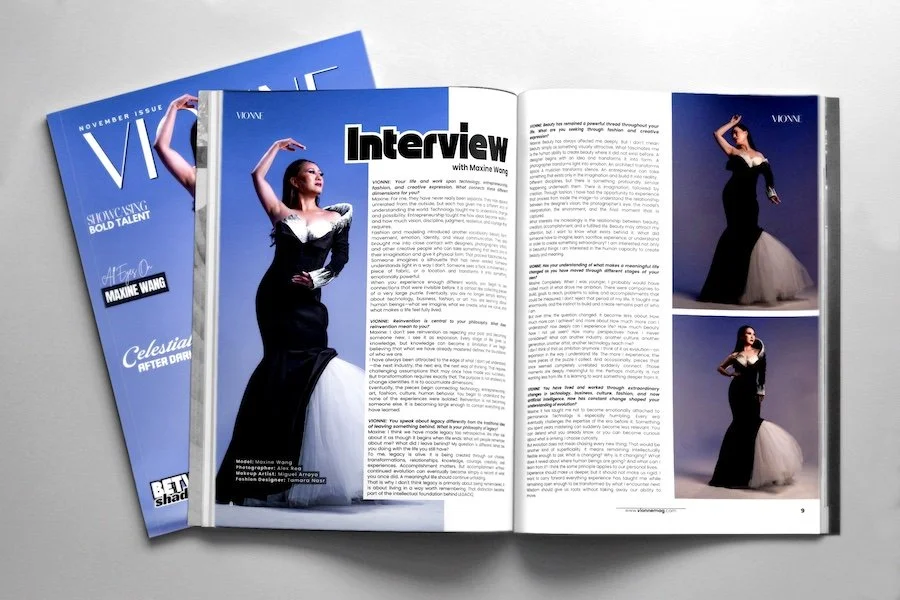
Want more?
Order Issue #19 to discover more powerful stories and explore exclusive features, interviews, and fashion highlights.
Available now online & in print-on-demand.